


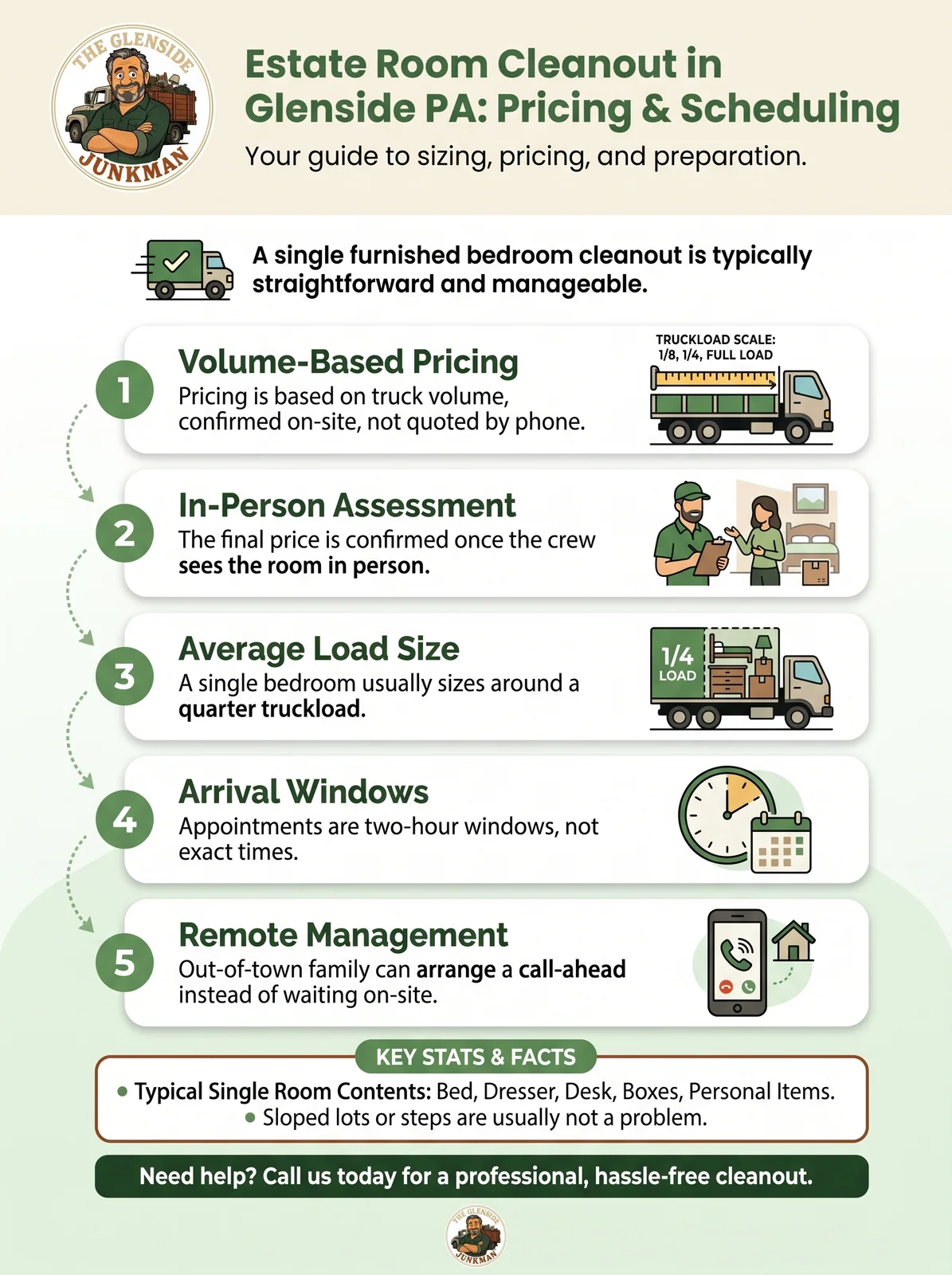
A single furnished bedroom — bed, dresser, desk, a few boxes of personal items — is one of the most manageable cleanouts a junk removal crew handles. It usually sizes out around a quarter truckload, and the final price gets confirmed once a crew sees the room in person, not over the phone. This guide walks through how that sizing and pricing actually works, what to prepare before the crew arrives, and how to manage the whole thing if you live out of state and can’t sit around waiting for a truck.
What you need to know before you call:
- Pricing is volume-based and confirmed on-site, not quoted sight-unseen by phone.
- Jobs get sized on a truckload scale — eighth, quarter, or full load — and a single bedroom typically lands near a quarter load.
- Appointments come as a two-hour arrival window, not an exact time slot.
- A sloped lot or a few steps to the street usually isn’t a problem for the crew.
- Out-of-town family can arrange a call-ahead instead of waiting on-site for two hours.
What a single-room cleanout actually involves
A single-room cleanout means exactly what it sounds like: everything in one bedroom gets hauled out, and nothing else in the house is touched. For a typical bedroom after a death in the family, that contents list looks fairly consistent from job to job.
- A twin bed — frame, mattress, box spring, and headboard
- A small shelf unit
- A desk
- An upright set of drawers or dresser
- Books and old CDs
- A small amount of men’s or women’s clothing
- Kitchen and eating utensils, pots, and pans stored in the room
- General trash and miscellaneous debris
That’s a contained job. One room, one doorway, one path out of the house. Compare that to a full apartment cleanout or a garage full of decades of accumulation, and you can see why a single room prices lower and moves faster. If the furniture removal is limited to that one room — a bed frame, a dresser, a desk — the job stays predictable in a way a whole-house cleanout rarely does.
Why crews ask “one room or the whole place?”
Phone intake almost always asks whether a job is an apartment cleanup, a garage, a basement, a construction cleanup, or something smaller like a single room. That question isn’t small talk. It determines crew size, truck sizing, and how long the job takes on-site.
If everything really is contained to one room — nothing scattered through hallways, no overflow into a garage or basement — say so clearly when you book. It keeps the estimate tighter and the crew doesn’t need to walk the whole house before giving you a number.
How junk removal pricing works, and why you won’t get an exact number over the phone
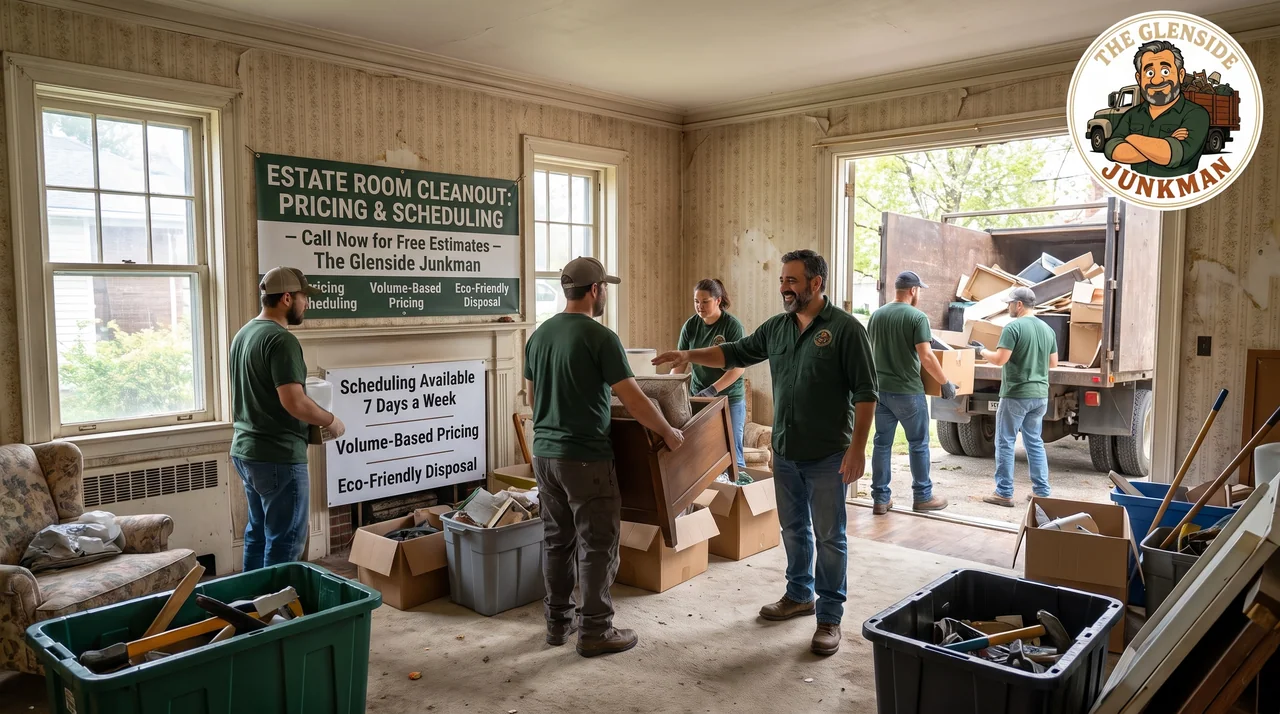
Most Junk Removal Glenside companies, including this one, don’t quote exact prices over the phone. That’s not evasiveness. Pricing is based on volume and weight, and those two things genuinely vary once a crew is standing in the room looking at what’s actually there versus what was described on a call.
Free on-site estimates are the standard across this industry. A crew looks at the load, confirms the price on the spot, and you decide whether to go ahead before anything leaves the house. If you want a closer ballpark before pickup day, send photos of the room when you book — it won’t replace the on-site estimate, but it narrows the range considerably.
Truckload sizing explained
Jobs get measured against a truckload scale rather than a flat per-item price. Three tiers come up constantly in estimates:
| Load size | Typical contents | Where a single bedroom usually falls |
|---|---|---|
| 1/8 truckload | A few items — a chair, a small appliance, a handful of boxes | Too small for a full furnished room |
| Quarter truckload | A bedroom’s worth of furniture plus boxes — bed, dresser, desk | Usually the right fit |
| Full load | An entire apartment, garage, or whole-house cleanout | Only if the job expands beyond one room |
A room with a twin bed, box spring, headboard, dresser, desk, and a handful of boxes almost always sits around a quarter truckload. That’s an estimate framework, not a published flat rate — final pricing still depends on what the crew sees when they arrive.
What affects the final price
Three things move the number up or down: total volume, how heavy or bulky the individual pieces are, and how hard the crew has to work to get everything out the door.
A mattress and box spring take up space but aren’t especially heavy. A solid wood dresser is the opposite — small footprint, real weight. Access matters too. A ground-floor room with no interior stairs is about as easy as it gets. A sloped driveway or a handful of steps down to the street rarely changes the quote; most crews treat that as routine, not an obstacle.
Before the crew arrives, confirm:
Does a sloped lot or a few steps add to the cost?
Usually not. A short run of steps down to street level and a moderate slope are treated as standard access, not a surcharge trigger. Crews flag it as a problem only when it genuinely slows the job down — long carries, narrow stairwells, or no vehicle access near the door at all.
How scheduling and arrival windows work
Bookings come as a two-hour arrival window — something like 9 a.m. to 11 a.m. — rather than an exact appointment time. Crews are routing multiple jobs in a day, and prior stops don’t always run on schedule, so a tight exact time isn’t realistic to promise.
That’s frustrating if you don’t live at the property and can’t justify sitting in an empty house for two hours. It’s a fair complaint. Nobody wants to burn half a morning waiting on a truck that might show up at 9:05 or 10:50.
What to do if you can’t wait around for a two-hour window
Ask the office to leave a note for the crew to call ahead before they arrive. That one request solves most of the problem — you get a real-time heads-up instead of guarding the door for two hours. A few other options work too: arrange a lockbox or key exchange, ask a neighbor to let the crew in, or request the earliest window of the day so there’s less drift from prior jobs.
Handling an estate cleanout when you live out of town
This is the scenario that generic cleanout articles skip entirely. You’re not local. Maybe you flew in for a funeral and you’re heading back home at the end of the week. You don’t have time to babysit an arrival window, and you can’t exactly run back for a second visit if something gets missed.
A few things make this manageable. Book as early as you can once a date is set — last-minute requests don’t always get next-day availability. Photograph the room before pickup day so the office has something concrete to work from. Confirm who, if anyone, will physically be at the property, and set up the call-ahead arrangement described above if that person can’t wait around.
Meeting the crew in person is common, and plenty of people prefer it — you get to point at what stays and what goes, on the spot. It just isn’t mandatory. With the right access arrangement, the job gets done whether you’re standing in the driveway or four states away.
Sorting keepsakes before the cleanout
Separate anything you want to keep, donate, or photograph before removal day. Books, CDs, clothing, photographs, small personal effects — these are easy to overlook in boxes that otherwise look like general clutter. A crew removes what you point to; it won’t second-guess what’s sentimental and what isn’t.
Take ten minutes with a box or a bag and go through anything that isn’t furniture. It’s a small step, and it’s the one people regret skipping more than almost anything else in this process.
Getting pricing and payment details before you book
If you want a cost ballpark or need to know accepted payment methods before pickup day, ask for that upfront rather than waiting until the crew is on-site. Phone intake can usually confirm scope and scheduling, but pricing and payment specifics sometimes need a callback from the office — better to get that settled a day or two ahead than to be sorting it out while the truck is idling outside.
Handling a single-room estate cleanout in Glenside or anywhere in the 19038 area? Call 267-536-4671 to ask about a free on-site estimate and get scheduling sorted before you fly back out of town.
If the job turns out to be bigger than one room — say it expands into a garage full of old appliance removal needs, or the family decides to clear the whole house instead of just one bedroom — it’s worth asking about dumpster rental as an alternative for jobs that stretch over several days instead of one visit.
Frequently asked questions
Can you give me a price over the phone?
Not an exact one, and that’s normal across the industry. Pricing is based on volume and weight, so a reputable company confirms the final number with a free on-site estimate once the crew can see everything in person. Sending photos ahead of time gets you a closer ballpark without replacing that on-site check.
How big a truck do I need for one furnished bedroom?
A room with a twin bed, dresser, desk, and a few boxes typically falls around a quarter truckload. That’s confirmed once the crew arrives — the 1/8, quarter, and full-load scale is an estimate framework, not a locked-in size.
Why is the appointment a two-hour window instead of an exact time?
Crews route several jobs in a day and prior stops don’t always wrap up on schedule, so an exact minute isn’t realistic to promise. If you can’t wait on-site, ask for a call-ahead note instead.
Do I have to be there for the cleanout?
No. Meeting the crew is common and plenty of people prefer it, but it isn’t required. A key, a lockbox, or a neighbor can handle access, and a call-ahead arrangement means you don’t need to wait around for the full two-hour window.
Do stairs or a sloped driveway cost extra?
Usually not. A few steps down to street level and a moderate slope are treated as routine access. Significant obstacles — long carries, no vehicle access near the door — are the kind of thing that can actually affect an estimate.
What items can be removed in a room cleanout?
Furniture, mattresses and box springs, dressers, desks, books, CDs, clothing, and kitchenware are all standard. General trash goes too. Hazardous materials are typically excluded, so check with the office if the room includes anything like old paint or chemicals.
How soon can a cleanout be scheduled?
Not always next-day — plan for a few days out, especially around a travel deadline. If you’re flying back out of town at the end of the week, book as soon as the date is confirmed rather than waiting until the last few days.