


Businesses and individuals can dispose of wooden pallets by recycling them, returning them to suppliers, selling or donating reusable ones, or hiring a local junk-removal service. The right path depends on pallet condition, how many you have, and whether a hauler actually services your location. A recent caller — a wholesale outlet with a stack of pallets to clear — hit every obstacle: wrong company, wrong state, no referral. This article gives the answers they never got.
What you need to know before you read on:
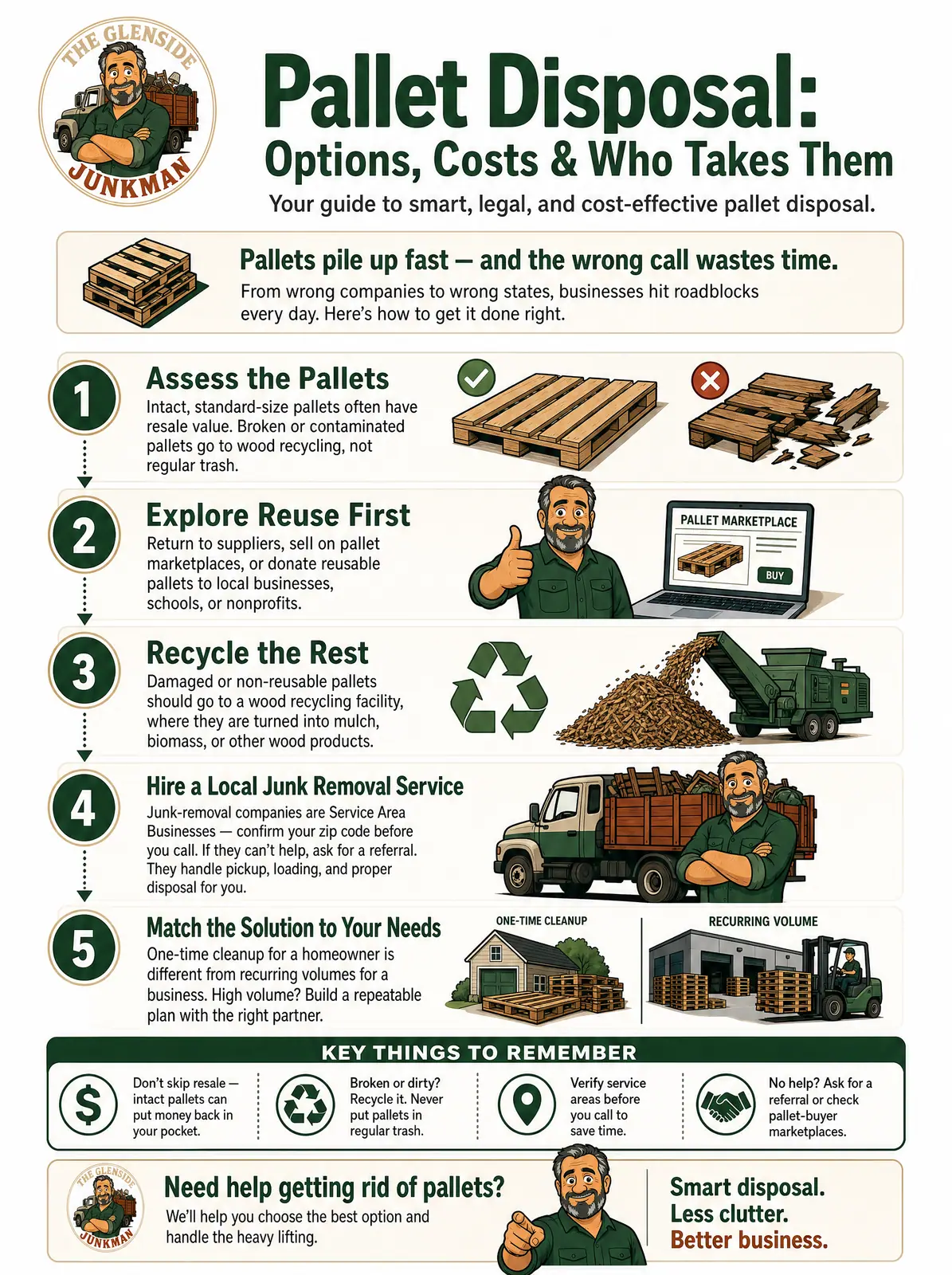
- Intact, standard-size pallets often have resale value — don’t skip that step.
- Broken or contaminated pallets go to wood recycling, not regular trash.
- Junk-removal companies are Service Area Businesses — confirm your zip before you call.
- If a hauler can’t help, ask for a referral or search pallet-buyer marketplaces.
- Commercial customers with recurring volume need a different solution than a one-off homeowner.
Why Pallets Pile Up Faster Than You Think
Every inbound shipment at a warehouse, retail outlet, or distributor arrives on pallets. Most of the time nobody sends those pallets back. Within weeks, a loading dock that started clear has a wall of stacked wood with nowhere to go.
That was exactly the situation for the wholesale outlet on the call. They did the right thing — picked up the phone and called a hauler. The problem? The hauler was in a different state and couldn’t help. If you’re in that position, here’s how to actually solve it.
Your Main Options for Getting Rid of Pallets
Before calling anyone, sort your situation by two factors: pallet condition and quantity. Those two variables determine which path makes the most sense.
Reuse or Sell Pallets That Are Still in Good Shape
Standard GMA pallets (48″ x 40″) in clean, dry, undamaged condition have real resale value. Pallet recyclers, freight companies, and small businesses actively buy them. Check for cracked boards, mold, or pest damage — any of those knock a pallet out of the resale category fast.
Online marketplaces and local pallet brokers are the quickest way to find buyers. Even a modest per-pallet rate adds up when you have a full stack.
Return Pallets to Your Supplier or a Pallet Pool
Some suppliers run exchange programs — they want their pallets back and will arrange pickup or credit your account. If your business receives regular shipments, ask your vendor whether a return or pooling arrangement is available. This is usually the cheapest option because the cost is already built into the supply chain relationship.
Recycle Pallets That Are Broken or Unusable
Damaged pallets — split boards, missing blocks, signs of mold — are not saleable, but they’re not trash either. Wood recyclers chip them into mulch, use them for biomass, or process the lumber for other purposes. Search your area for wood-recycling drop-off sites or contact your municipal waste authority to ask what they accept.
Hire a Junk Removal or Hauling Service
When you have a large quantity, mixed loads (pallets plus other debris), no truck of your own, or simply no time — hiring a hauler is the fastest path to a clear loading dock. A hauler loads everything in one trip and handles disposal logistics. This is the route the wholesale outlet caller was trying to take. For local businesses in the Philadelphia suburbs, a service like Junk Removal Glenside handles exactly this kind of commercial pickup.
How Much Does Pallet Disposal Cost?
Cost depends on several variables. No honest article gives you a flat rate because haulers price differently and regional disposal fees vary. Here’s what drives the number:
| Cost Factor | What It Affects |
|---|---|
| Quantity of pallets | More volume = larger load = higher price tier |
| Pallet condition | Reusable pallets may offset cost; broken ones add tipping fees |
| Mixed load vs. pallets only | Mixed debris uses more truck space, priced accordingly |
| DIY vs. hired hauler | DIY drop-off saves labor cost; hauler saves your time |
| Your location | Out-of-area jobs may be declined entirely — as the caller discovered |
The caller on that call never received a quote — the job ended before pricing came up because the address was out of the hauler’s service area. Confirming coverage first saves everyone time.
How to Confirm a Hauler Actually Services Your Location
This is the real lesson from that call. The caller reached a company that flat-out said, “We don’t service at state.” A wasted call, no solution, no referral.
Junk-removal companies are typically Service Area Businesses. They define coverage by zip code or county — not by phone number or website ranking. A company that ranks for your city search may physically operate 200 miles away.
- Check the website’s service area page — look for a zip code list or map before you call.
- State your address in the first sentence when you do call — “I’m at [address], do you service here?”
- Ask specifically about commercial pallet disposal — some haulers handle residential only.
- Confirm before scheduling — don’t assume a booking confirmation means coverage is verified.
What to Do If No One in Your Area Covers You
The caller asked for a referral and got nothing. Here are better next steps if you hit that wall:
- Search “pallet recycler near me” or “wood recycling [your city]” for local facilities that accept drop-offs.
- Contact regional freight or logistics companies — they often have pallet-exchange contacts.
- Check pallet-buyer marketplaces online where local buyers post wanted listings.
- Try a national hauling chain with broader geographic coverage, then confirm your zip is in their range.
Step-by-Step: Clearing Out a Stack of Pallets
- Sort by condition. Separate pallets that are intact and dry from those that are cracked, moldy, or broken. These go two different directions.
- Count and measure. Know how many pallets you have and roughly how much space they occupy. This is the information a hauler needs to quote a load size.
- Choose your path. Reusable pallets: sell or return. Broken pallets: recycle or haul. Mixed loads with other debris: hauler is simplest.
- Confirm service coverage. Before you call any hauler, verify they service your address. State your location first on the call.
- Schedule pickup or drop-off. Lock in a date and get written confirmation of price and scope before the truck rolls.
Pallet Disposal for Businesses vs. Homeowners
The scale is completely different. A homeowner with four pallets from a home-improvement project needs a one-time solution — sell them locally or have a hauler take them with other debris.
A wholesale outlet, warehouse, or distributor accumulates pallets continuously. That calls for a recurring arrangement: a supplier return program, a standing account with a pallet recycler, or a scheduled commercial pickup. One-off calls to residential junk-removal companies are the wrong tool for ongoing commercial volume.
If your business generates regular debris beyond pallets — old shelving, equipment, packaging materials — it’s worth asking about appliance removal and bulk commercial pickup in the same conversation.
When Hiring a Hauler Is Simply the Easiest Answer
For large or mixed loads — pallets alongside old furniture, broken equipment, or general cleanout debris — a local junk-removal service that handles it all in one trip is the path of least resistance. You make one call, one truck comes, one invoice gets paid.
If you also need to clear out furniture or larger items at the same time, combining furniture removal with your pallet pickup into a single load often makes the most economic sense.
In the Glenside, PA area and need pallets or commercial debris hauled away? Call (267) 536-4671 to confirm coverage and get a straight answer on pricing — no runaround, no wasted trips.
Frequently Asked Questions
Can I throw wooden pallets in the regular trash?
Usually not in bulk. Most curbside collection programs don’t accept stacks of pallets, and many municipalities restrict bulk wood from standard trash pickup. Recycling or hiring a hauler is the practical alternative.
Are pallets recyclable?
Yes. Wooden pallets can be recycled into mulch, repaired for reuse, or processed as wood waste at recycling facilities. Plastic pallets are also recyclable through appropriate plastic-recovery programs.
How do I know if my pallets are worth money?
Standard-size (48″ x 40″), undamaged, dry, and mold-free pallets typically have resale value to pallet recyclers or freight companies. Cracked boards, moisture damage, or mold disqualify a pallet from resale — those go to recycling or hauling.
Will a junk removal company pick up just pallets?
Many will, particularly for bulk commercial quantities. The critical step is confirming they service your specific address before scheduling. As one out-of-area caller found out, a company that ranks locally may not physically operate in your state or zip code.
What if the company I call doesn’t cover my area?
Ask for a referral first. If they can’t help, search for local wood recyclers, pallet-buyer listings, or a regional hauler with broader coverage. Always confirm service area before booking — it saves a wasted call.
How many pallets fit in a single junk removal load?
It depends on the hauler’s truck size and how the pallets are stacked. Ask the company how they price by volume and whether pallets count as a standard or oversized item. A rough count and a photo of your stack helps them give you an accurate answer quickly.
Still have a recurring pallet problem and wondering whether a dumpster might make more sense than scheduled pickups? Check out the details on dumpster rental as an ongoing commercial solution — it may be a better fit for high-volume operations.