


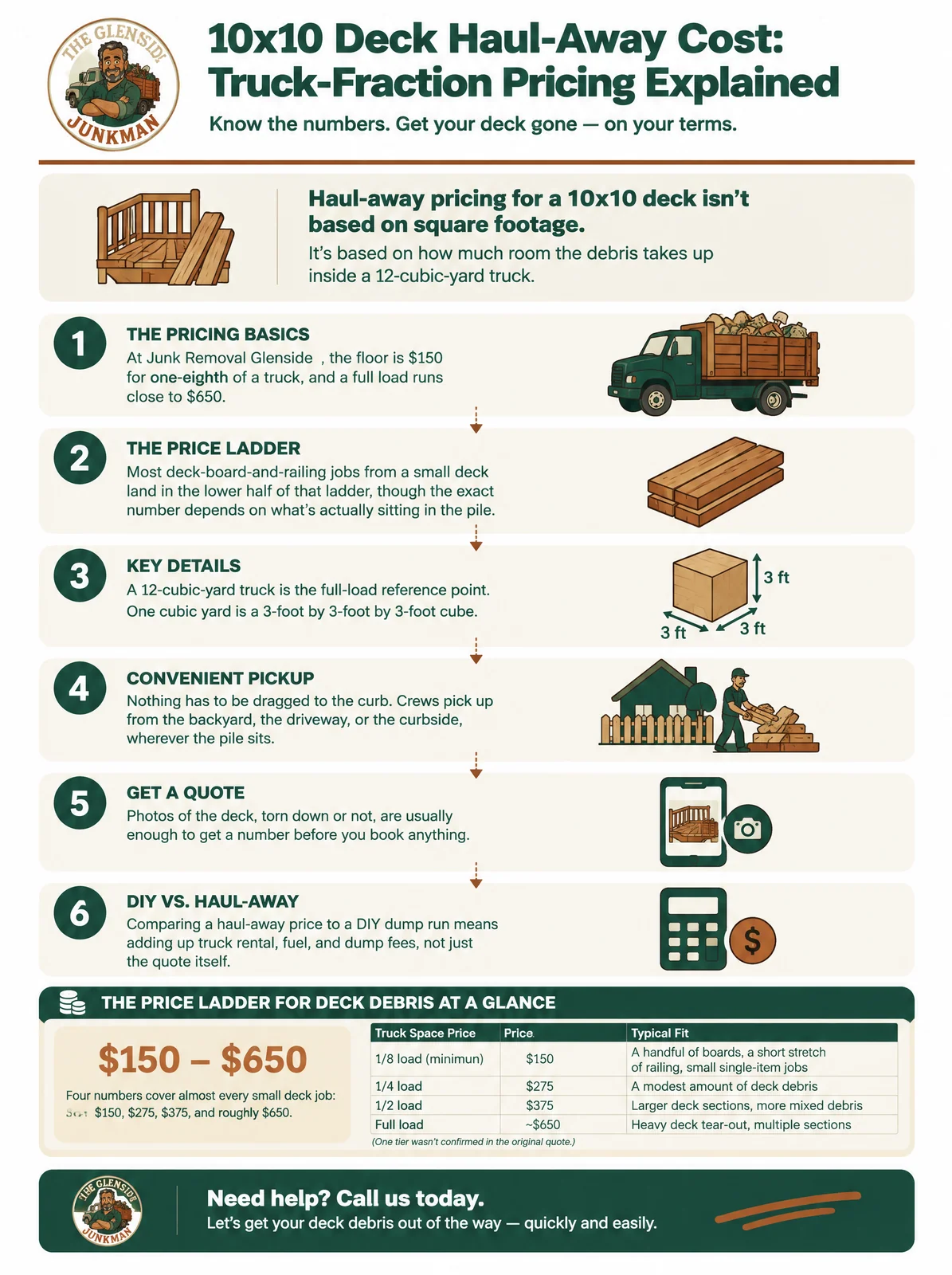
Haul-away pricing for a 10×10 deck isn’t based on square footage. It’s based on how much room the debris takes up inside a 12-cubic-yard truck. At Junk Removal Glenside, the floor is $150 for one-eighth of a truck, and a full load runs close to $650. Most deck-board-and-railing jobs from a small deck land in the lower half of that ladder, though the exact number depends on what’s actually sitting in the pile.
What you need to know before you pick up the phone:
- Pricing follows truck space, not the number of pieces: $150 for 1/8 load, $275 for 1/4, $375 for 1/2, and about $650 for a full load.
- A 12-cubic-yard truck is the full-load reference point. One cubic yard is a 3-foot by 3-foot by 3-foot cube.
- Nothing has to be dragged to the curb. Crews pick up from the backyard, the driveway, or the curbside, wherever the pile sits.
- Photos of the deck, torn down or not, are usually enough to get a number before you book anything.
- Comparing a haul-away price to a DIY dump run means adding up truck rental, fuel, and dump fees, not just the quote itself.
The Price Ladder for Deck Debris at a Glance
Four numbers cover almost every small deck job: $150, $275, $375, and roughly $650. Nothing in between those is a flat rate per board or per railing section. The table below lays out the full ladder as it was quoted, with a note on the one tier that wasn’t confirmed.
| Truck Space | Price | Typical Fit |
|---|---|---|
| 1/8 load (minimum) | $150 | A handful of boards, a short stretch of railing, small single-item jobs |
| 1/4 load | $275 | Most small deck tear-outs: boards plus railings |
| 1/2 load | $375 | Boards, railings, and some framing or posts |
| 3/4 load | Not confirmed on the call — ask when you send photos | Larger decks or a deck plus other yard debris |
| Full load | About $650 | Full tear-outs with framing, stairs, and posts, or combined cleanouts |
Notice the gap isn’t even. Moving from an eighth of a load to a quarter adds $125, not $150. That’s worth remembering, because it trips people up constantly — a lot of callers assume the price climbs in flat steps and guess the quarter-load price should land around $300. It doesn’t. The final number still comes from photos, not a formula.
How Truck-Fraction Pricing Actually Works

The crew isn’t counting boards or measuring square footage of your old deck. They’re estimating how much physical space your pile will take up once it’s loaded into the truck bed. A compact stack of flat boards takes less room than the same boards scattered loose. That’s the entire model.
What a 12-Cubic-Yard Truck Actually Means
A cubic yard is a cube measuring three feet on every side. Picture a box roughly the size of a washing machine stood on its end, and you’re close. A 12-cubic-yard truck holds twelve of those boxes’ worth of volume. When someone says “1/8 load,” they mean about 1.5 cubic yards of debris sitting in that truck bed.
Why the Minimum Already Covers an Eighth of a Load
The $150 minimum isn’t a flat trip fee charged on top of whatever space you use. It already buys you up to 1/8 of the truck. Small. So even a single couch, a mattress, or a short run of deck railing gets booked at that same starting price, because it isn’t worth splitting into a smaller fraction.
How Much Room Does a 10×10 Deck’s Debris Take Up?
A 10×10 deck covers about 100 square feet of surface, but surface area doesn’t translate directly to truck volume. Flat boards stack efficiently. Railings and spindles don’t, because they’re full of gaps and odd angles. What actually fills a truck depends on exactly what comes off that deck.
A stripped-down job, decking boards and railings only, with the joists and posts left in place, often lands closer to the 1/8 to 1/4 range for a deck this size. That’s a general expectation based on how lumber typically stacks, not a quote, and it isn’t confirmed for this specific job. If the framing, support posts, and any stairs come out too, the pile grows fast, and a quarter load can turn into a half load without much warning.
A few things move the number up or down:
- Whether the joists and support posts come out, or just the decking surface itself
- Whether there’s an attached staircase that also gets torn apart
- The material involved, since pressure-treated lumber stacks differently than composite decking
- Whether other yard debris gets tossed onto the same pile while you’re at it
None of that replaces an actual look at your pile. Photos settle it faster than any rule of thumb ever will.
Getting a Price Before (or After) You Tear Anything Out
You don’t need to wait until the deck is in pieces to get a number. One caller had an intact deck, a teardown planned for the next day, and a straightforward question: what’s this going to cost? The answer was to send pictures first, then confirm again once the pile existed, if needed.
Four things are worth photographing:
- The whole deck from a few feet back, showing its length and width
- Close-ups of the railing sections
- Any stairs or attached structures coming down with it
- The stacked pile once it’s torn apart, if you wait until after demolition
A photo-based estimate is a real quote, built off how much space the pile will occupy. It isn’t a guess pulled from a square-footage chart. If the pile ends up bigger or smaller once it’s actually stacked, a second set of photos after teardown locks in the final number.
Does the Debris Have to Be at the Curb?
No. The pile can sit in the backyard, right where it fell, in the front yard, or at the curb. Whichever is easiest for you. Nobody needs to drag deck boards across the lawn or down a driveway just to make a crew’s job easier.
That matters more than it sounds like for a deck project specifically, since the debris is usually sitting exactly where the deck used to stand, often behind the house and nowhere near the street. Clear access to the pile still helps things move faster, but that’s a convenience, not a requirement.
Hauling It Away vs. Renting a Truck and Dumping It Yourself
Here’s the real question behind most of these calls: is it actually cheaper to rent a truck and make the dump run yourself? The honest answer is that it depends on your time, your vehicle situation, and your local dump fees. Run the numbers before assuming either direction wins.
| Cost Factor | Hiring a Hauler | Doing It Yourself |
|---|---|---|
| Base cost | $150 to $275 for most small deck jobs | Truck or trailer rental fee, plus mileage |
| Dump fees | Included in the quoted price | Paid separately at a transfer station or landfill |
| Labor | Crew loads and hauls it | You load it, drive it, then unload it again |
| Time | One scheduled pickup window | Rental pickup, the drive, unloading, and returning the truck |
| Vehicle wear | None, it’s their truck | Your vehicle or a rented one takes the load |
Add up the rental, the fuel, the dump fee, and a few hours of your weekend, and a $150 to $275 haul-away often ends up competitive once everything’s counted. It won’t always win, especially if you already own a truck and live close to a transfer station. But if you’re weighing a bigger renovation and considering a container instead of a single pickup, a dumpster rental is the other option worth pricing against both of these.
Not sure which side of that math you land on? Send a few photos of the deck and get a real number back before you decide whether to rent a truck or book a pickup. Call 267-536-4671 to talk through it.
Getting the Deck Ready for Pickup
A little prep work can keep the pile in a lower tier and make the pickup faster. None of this requires special tools, just some time with gloves on.
Before the crew arrives
What about disposal rules for treated lumber?
Pressure-treated wood sometimes falls under different disposal handling than plain lumber or composite decking, depending on local rules. Ask when you send your photos whether your specific boards need anything separated out, since that can affect how the pile gets loaded.
What Can Push the Job to the Next Tier
A quote based on boards and railings can shift once the teardown actually starts. A few common reasons:
Pulling out the joists, support posts, and any attached stairs adds real volume fast. A deck that looked like a quarter-load job on paper can turn into a half load once the framing comes up too. That’s not a hidden fee, it’s just a bigger pile than what the first photos showed.
Combining projects matters too. If you’re clearing out the shed at the same time and tossing an old loveseat or a broken patio grill onto the same pile, that extra volume gets counted in the same load. In that case, booking a separate furniture removal or appliance removal pickup might actually keep each job in a cheaper tier instead of bumping the whole thing up.
Either way, the fix is the same: send updated photos once the pile is final, and the price adjusts to match what’s really there.
Ready to Book? What to Have on Hand
Have your photos ready, a rough sense of how big the pile is, and whether the deck is still standing or already torn apart. That’s enough to get a real number. Call 267-536-4671 and talk through the job before anything gets loaded.
Frequently Asked Questions
How much does it cost to haul away a 10×10 deck?
Pricing runs from $150 for an eighth of a truck up to about $650 for a full load. The final number depends on how much space the actual debris takes up, which a photo estimate confirms. A small deck with just boards and railings often lands toward the lower end of that range, though that’s a general expectation, not a quote.
What does “1/8 of a truck” mean?
It means one-eighth of a 12-cubic-yard truck, roughly 1.5 cubic yards of debris. That’s also the minimum booking size, priced at $150.
Why is a quarter truck $275 and not $300?
Because the pricing ladder isn’t evenly spaced. The jump from $150 to $275 is $125, not a flat $150 step. Guessing the pattern climbs by even increments is a natural assumption, but it doesn’t hold here.
Can I send photos instead of getting an on-site estimate?
Yes. Photos of the deck, whether it’s still standing or already in pieces, are usually enough to assess space and give a real estimate. You can send them before or after teardown.
Do I have to move the deck debris to the curb?
No. Pickup happens from the backyard, the front of the house, or the curb, wherever the pile already sits.
Is hauling it away cheaper than renting a truck myself?
It depends. Add up truck or trailer rental, fuel, and dump fees against a $150 to $275 quote for a small deck job, and the gap often shrinks or disappears. It’s not a flat answer either direction.
Do you take railings and framing as well as deck boards?
Boards and railings are the core of most deck jobs. Framing, posts, and stairs typically count as additional volume on top of that, which can move the job up a tier. Confirm specifics when you send your photos.