


Yes, junk removal crews in Glenside can haul out heavy commercial kitchen equipment like fryers, dough proofers, and prep tables — and this kind of job is usually estimated and priced as a full truckload, not by the item. A real call about a restaurant cleanout with “a couple fryers, tables, dough proofers” got sized up fast as “probably a full truckload.” This article breaks down what gets removed, how load size and pricing actually work, and how scheduling plays out for a restaurant closeout in Glenside, PA.
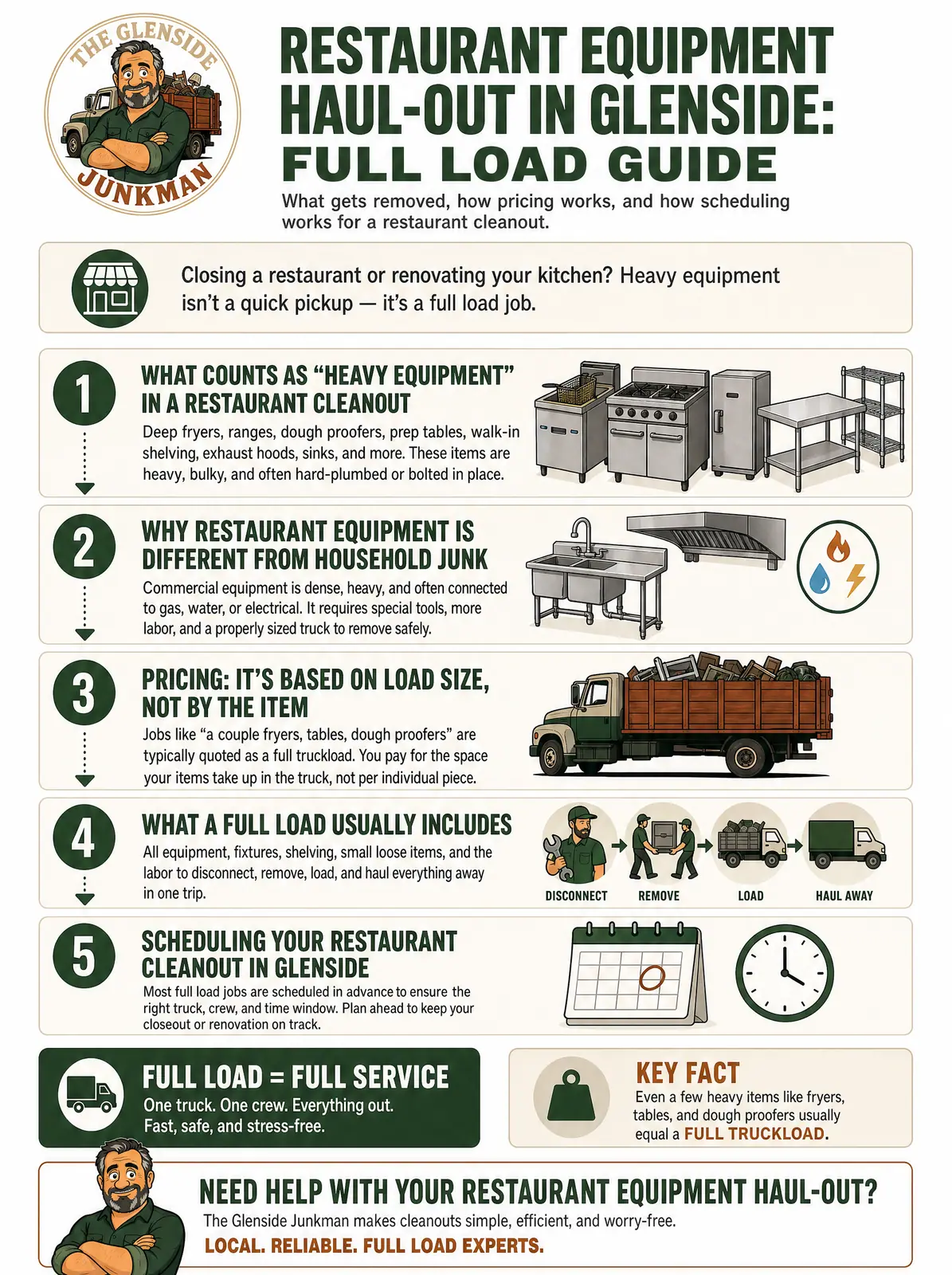
What Counts as “Heavy Equipment” in a Restaurant Cleanout
Commercial kitchen equipment covers everything a working restaurant needs to cook, prep, and serve food — and almost all of it needs to come out during a closeout or renovation. The most common items include:
- Deep fryers, ranges, and flat-top griddles
- Dough proofers and mixers
- Stainless steel prep tables and dining tables
- Walk-in cooler shelving and wire racks
- Exhaust hoods, sinks, and dish stations
These pieces are heavier, bulkier, and often bolted or hard-plumbed compared to typical household junk. That’s exactly why the equipment mentioned in the call — fryers, tables, and dough proofers — was flagged right away as more than a quick single-item pickup.
Why Restaurant Equipment Is Different From Household Junk
A couch or a mattress is bulky but light enough for two people to carry. A commercial fryer is dense steel, sometimes still holding oil residue, and often wired or gas-connected. Prep tables and proofers add volume fast. That combination of weight, grease, and disconnection needs is why a restaurant cleanout gets treated as a bigger job from the first phone call, not as a handful of separate pickups.
How Junk Removal Is Sized by Truck Load
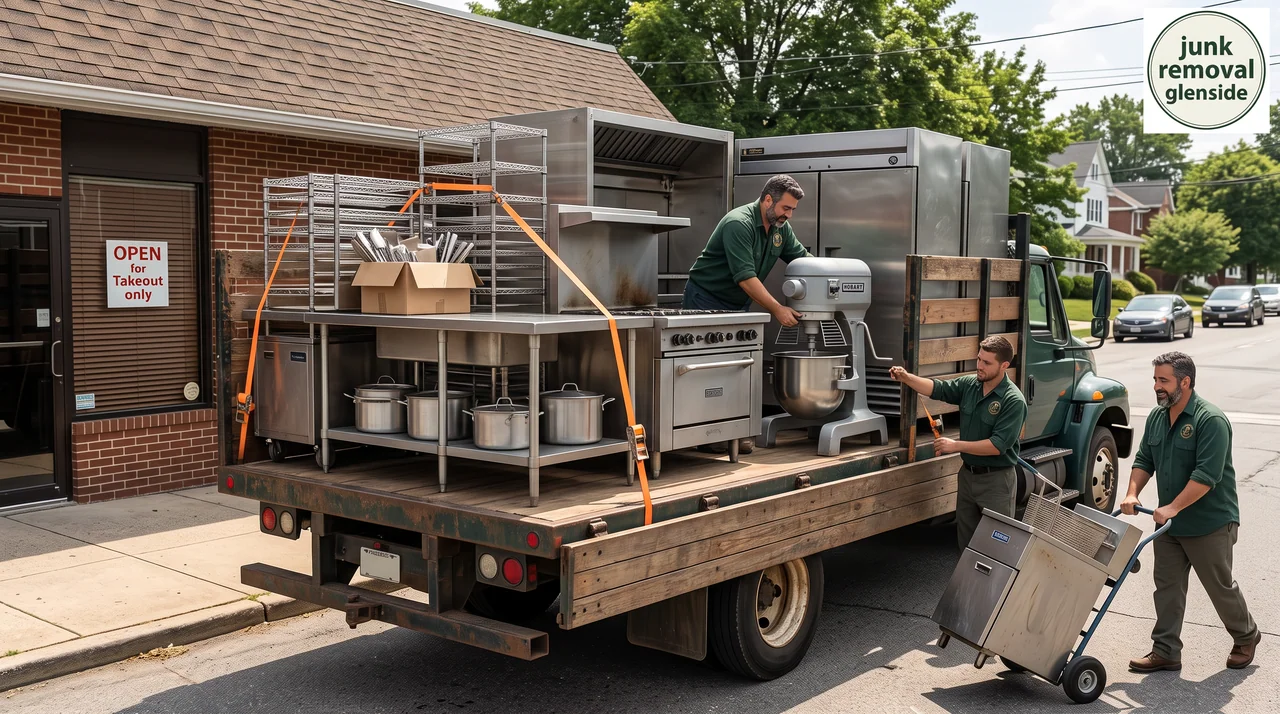
Most junk removal pricing in Glenside isn’t based on counting individual items — it’s based on how much of a truck the job fills. In the call referenced above, the question wasn’t “how many fryers” — it was whether the job looked like “1 eighth or 1 quarter” of a truck. For a full commercial kitchen, the answer landed on a full load.
Here’s how that sizing typically breaks down:
| Load Size | Roughly Equivalent To | Common Use Case |
|---|---|---|
| 1/8 Truck | A few small items | Single appliance or piece of furniture |
| 1/4 Truck | A small room’s worth | Office cleanout, small storage area |
| 1/2 Truck | A garage or basement’s worth | Partial renovation debris |
| 3/4 Truck | A large room or multiple rooms | Bigger commercial cleanout |
| Full Load | An entire truck bed | Full kitchen closeout — fryers, tables, proofers |
Estimating a Restaurant Closeout Load
Before calling, walk through the space and picture it stacked in a truck bed. A few fryers, a run of prep tables, and a dough proofer almost always add up to a full load on their own — before you factor in shelving, small appliances, or dining furniture. If you’re not sure, describing what’s in the kitchen (fryers, tables, proofers, ranges) gives a crew enough to estimate accurately over the phone, the same way it worked in the call that inspired this article.
What a Full-Load Kitchen Haul-Out Typically Costs
A full-load commercial equipment removal generally costs more than a household full load because of the added weight and disposal handling for grease-laden equipment. A figure of $500 came up in one restaurant haul-out call, but that number isn’t a fixed rate — it depends on the actual load size, the weight of the equipment, and how accessible the space is. [verify pricing before booking, as it varies by job].
Several factors typically push cost up or down:
- Total weight of the fryers, ranges, and metal furniture
- Whether equipment still needs gas, electric, or water disconnection
- Stairs, tight hallways, or loading dock access
- Grease or oil residue that needs special disposal handling
- Whether the job is a full load or a smaller partial load
If your cleanout also includes a large amount of construction debris from a gut renovation, it’s worth comparing the cost of a full-load pickup against a dumpster rental left on-site for a longer project timeline.
Booking and Scheduling: Why “As Soon As Possible” Isn’t Always Same-Day
Wanting equipment gone “as soon as possible” is normal for a closing restaurant, but same-day pickup isn’t always available — especially for a heavy commercial job. In the call this article is based on, the business was closed for two days straight, and the earliest opening was several days out. That’s a realistic outcome for larger jobs, not a rare exception.
Heavy equipment removal often takes more planning than a same-day couch pickup because crews need to know the load size, confirm access, and sometimes bring extra hands for the weight involved. Booking a day or two ahead gives you a much better shot at a convenient time slot.
How Appointment Windows Work
Junk removal jobs in Glenside are typically booked in two-hour arrival windows — for example, 9am to 11am, 11am to 1pm, 1pm to 3pm, or 3pm to 5pm. Picking a window that matches your restaurant’s off-hours or a landlord’s access schedule makes the pickup smoother for everyone, especially when a crew needs a clear path to move fryers and tables out the door.
Preparing Your Restaurant for an Equipment Haul-Out
A little prep before the truck arrives keeps a full-load kitchen cleanout fast and safe. Before pickup day, it helps to:
- Disconnect gas, electric, and water lines from fryers, ranges, and proofers
- Drain any remaining oil or grease from fryers where possible
- Clear a path from the kitchen to the loading area or back door
- Confirm who has keys or building access on pickup day
- Separate any furniture that needs furniture removal from equipment that needs appliance handling
Since fryers, proofers, and commercial ranges fall under heavier appliance removal than a typical home kitchen, mentioning them upfront helps a crew bring the right equipment and manpower for the load.
Access and Location Details That Matter
Crews handling a full-load commercial job will usually ask for the exact pickup address, the best contact number, and any access notes — loading dock, back alley, stairs, or a locked gate. This isn’t extra paperwork; it’s what keeps a heavy job on schedule once the truck shows up.
Talking to a Real Person vs. an Automated Line
It’s a fair reaction to want a live person on the phone when you’re describing fryers, dough proofers, and a full commercial kitchen — an automated system can only go so far with a job this specific. If you get routed to an automated line first, asking directly for a representative, or leaving a message for a callback, is the fastest way to get accurate scheduling and pricing for equipment this heavy.
For a commercial haul-out in Glenside, it’s usually worth a direct conversation before booking a window.
Planning a restaurant equipment haul-out in Glenside? Call Glenside Elite Junk Removal at 267-536-4671 to describe your fryers, tables, and proofers and get an accurate load estimate before you book.
For general residential or commercial pickups outside of restaurant equipment, the Junk Removal Glenside team handles everything from single-item hauls to full-property cleanouts across the area.
Frequently Asked Questions
Can junk removal companies haul out commercial kitchen equipment like fryers and proofers?
Yes. Fryers, dough proofers, prep tables, and similar commercial kitchen items are commonly removed during restaurant cleanouts. Equipment with grease residue or active gas/electric connections may need some prep work before pickup.
How much of a truck does a restaurant equipment cleanout usually fill?
A full kitchen’s worth of fryers, tables, and proofers typically fills an entire truck load rather than a partial one. That’s the conclusion reached in a real call describing this exact combination of equipment — “full load makes sense for that kind of stuff.”
How much does it cost to remove a full load of restaurant equipment in Glenside?
Pricing depends on the total weight, the number of pieces, and site access. A figure of $500 has come up for a full-load restaurant haul-out, but this should be confirmed directly for your specific job rather than treated as a fixed rate. [verify]
Can I get same-day restaurant equipment removal in Glenside?
Sometimes, but not always. Heavy commercial loads and business closed days can push the earliest available slot out several days, so booking ahead is the safer bet if you’re on a closing deadline.
Do I need to disconnect the equipment before pickup?
Yes. Disconnecting gas, electric, and water lines — and draining any remaining oil from fryers — beforehand keeps the pickup safe and lets the crew move faster once they arrive.
How do arrival windows work?
Most jobs are booked into two-hour windows, such as 9am to 11am or 1pm to 3pm. Choosing a window that fits your restaurant’s operating hours or a landlord’s access schedule makes the pickup day easier to manage.
Next step: if you’re closing out or renovating a restaurant in Glenside, gather a rough list of what’s leaving the building — fryers, tables, proofers, shelving — and call ahead to lock in a load estimate and an arrival window before your move-out date arrives.