
If your boat still has resale value — it runs, it floats, you have a clear title — you sell it and someone pays you. If it’s truly junk — rotted hull, no paperwork, sitting in your driveway for years — you pay a removal service to haul it away. Those are two completely different transactions, and mixing them up is exactly what happened on a recent call: a customer asked if we “buy” junk boats, expecting to get paid, when the service actually works the other way around.
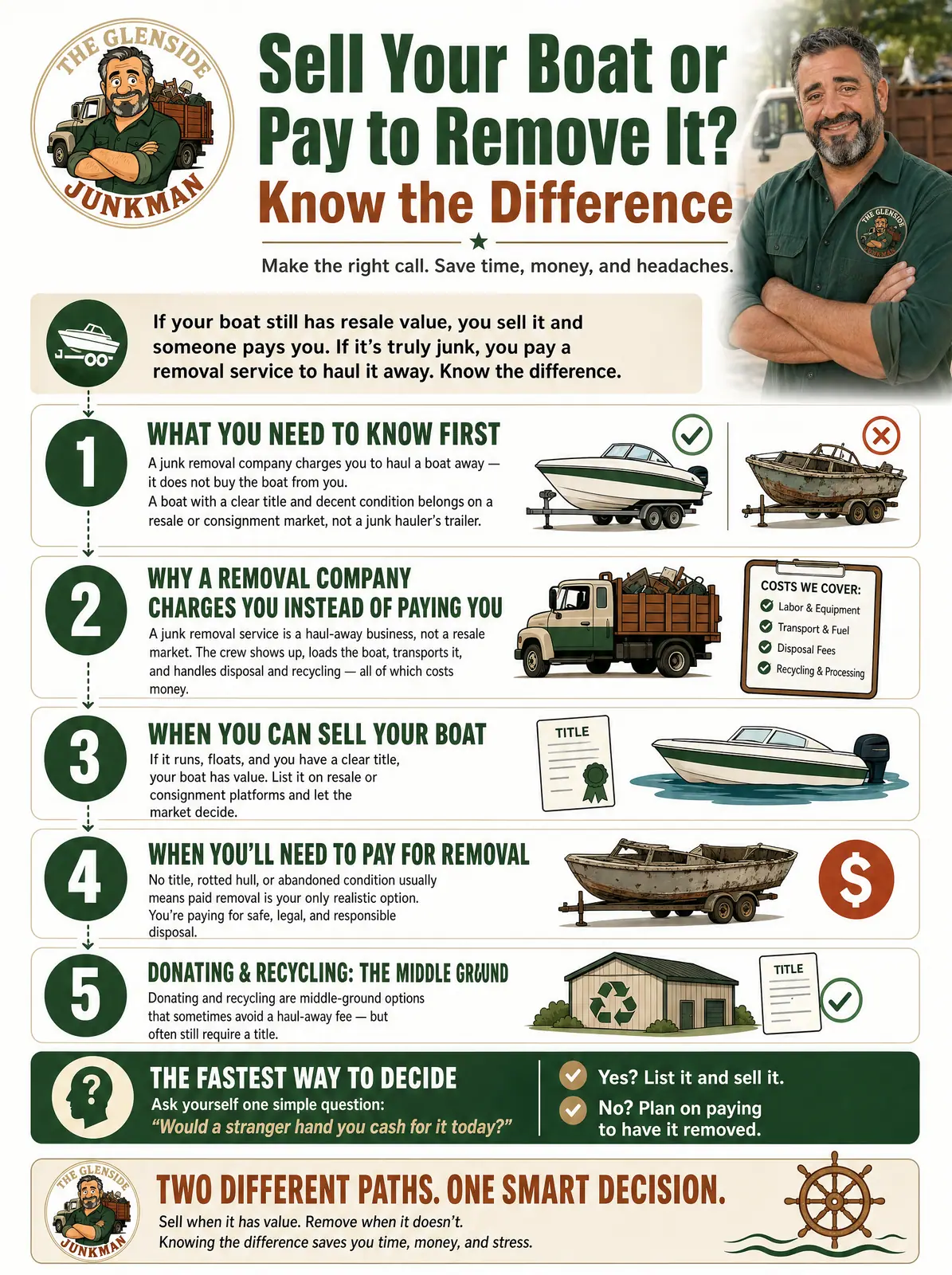
What You Need to Know First
- A junk removal company charges you to haul a boat away — it does not buy the boat from you.
- A boat with a clear title and decent condition belongs on a resale or consignment market, not a junk hauler’s trailer.
- No title, rotted hull, or abandoned condition usually means paid removal is your only realistic option.
- Donating and recycling are middle-ground options that sometimes avoid a haul-away fee — but often still require a title.
- The single fastest way to decide: ask yourself whether a stranger would hand you cash for it today.
Why a Removal Company Charges You Instead of Paying You
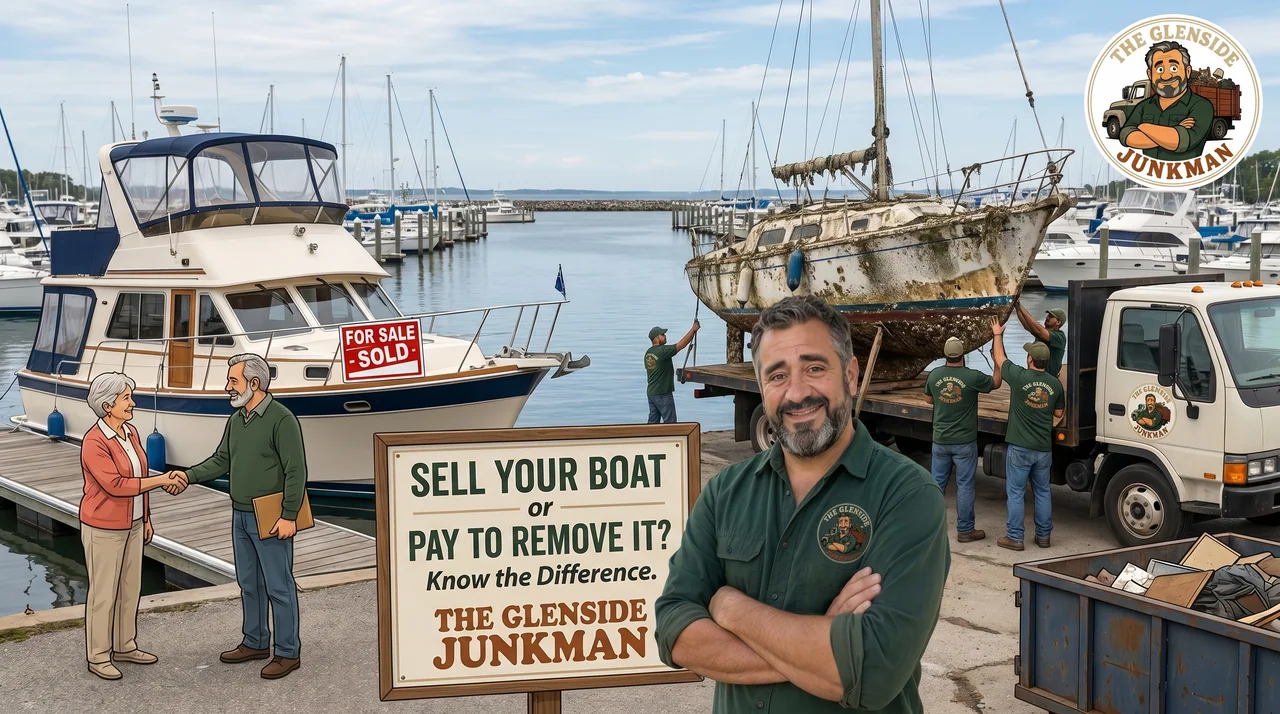
This is the exact confusion from the call. The caller asked: “Do you buy boats, like junk boats?” The answer was clear: “We don’t buy them — we charge to remove boats.” The caller repeated it back, genuinely surprised: “You charge to get it, to remove it?”
Yes. Here is why.
A junk removal service is a haul-away business, not a resale market. The crew shows up, loads the boat, transports it, and handles disposal — fiberglass recycling, scrap metal, draining fuel and oil, dumping fees. Every step costs money. There is no margin in a derelict boat that offsets those costs, so the labor and disposal are passed to you, the owner who needs it gone.
This is no different from paying to have a concrete slab or a pile of construction debris removed. The material has no value to the hauler. You are paying for the service of it disappearing.
The caller then asked: “You don’t know a person that takes used boats like they take used cars?” That is a different market entirely — and worth understanding before you make any calls.
Signs Your Boat Is Worth Selling
Before you dial anyone, run through these checks. If you can answer yes to most of them, you have a resale situation, not a removal job.
Do You Have a Clear Title and Registration?
A transferable title is the single biggest factor. Just like selling a used car, most private buyers, dealers, and consignment marinas will not touch a boat without paperwork. Pennsylvania requires a title for motorized boats. If you have it, your boat can legally change hands. Without it, your selling options shrink fast and removal becomes more likely.
Is It Running, Floating, and Structurally Sound?
A working engine, a hull that holds water, and an intact trailer are the three condition factors that preserve value. Even a non-running boat can sell for parts if the trailer is good and the hull is not rotted. Ask yourself: would someone tow it home and use it within a season with reasonable effort? If yes, it has value.
Where to Sell a Used Boat
The caller wanted to know if dealers “take used boats like they take used cars.” The honest answer: some do, but it is far less common and far less standardized than the used-car market. Your realistic channels are:
- Private sale — online boat marketplaces and local classified listings reach buyers directly.
- Marina or dealer consignment — the dealer sells it for you and takes a commission. Expect this to take weeks or months.
- Trade-in — some dealers accept trade-ins toward a new purchase, but only for boats in decent shape with a title.
- Boating club or forum listings — enthusiasts often buy project boats at low prices for parts or restoration.
Set realistic expectations. “Like they take used cars” overstates how organized the used-boat market is. But if your boat has a title and runs, someone will buy it.
When Paying for Removal Is the Right Move
Once a boat crosses into true junk territory, trying to sell it wastes time. Paid removal is not a punishment — it is just the appropriate service for a specific kind of problem.
Signs the Boat Belongs on a Hauler’s Trailer, Not a Listing
- No title, and tracing the paperwork would cost more than the boat is worth.
- Hull is cracked, rotted, or holed — structurally unusable.
- Engine is seized or completely missing.
- Inherited or abandoned — you have no history and no documentation.
- It has been sitting in a driveway or yard for years and you just need the space back.
These boats have no realistic buyer. Listing them wastes weeks. The practical solution is a paid Junk Removal Glenside service that hauls them out and handles disposal properly.
What a Boat Removal Job Actually Involves
When you hire a hauler for a boat, the process typically goes: assessment of size and condition, draining any remaining fuel and oil (hazardous fluids need to be handled separately before loading), rigging the boat onto a trailer, transport, and then disposal — which for fiberglass means specialized recycling, and for metal components means scrap. Each of those steps carries a cost, which is why the fee exists. Ask for a clear price upfront before any work starts.
Donating or Recycling: The Middle Path
Between selling and paying to remove, there are a few lower-cost alternatives worth knowing.
- Charity donation — some nonprofits and sea-scout programs accept boat donations. A title is usually still required. Verify local availability before counting on this option.
- Scrap or recycling — metal hulls and trailers can go to a scrap yard. Fiberglass is harder to recycle but some facilities accept it. You may get a small scrap payment for the metal.
- Parts sale — strip reusable parts (motor, electronics, trailer axles) and sell them individually before paying to haul the shell. This reduces the size of the removal job and may offset part of the cost.
None of these are as clean as a simple removal booking, but they are worth exploring if the boat has any salvageable components. For everything else on a property that needs clearing, appliance removal and furniture removal follow the same paid-haul model — you pay for the labor and disposal, not the other way around.
Decide in 60 Seconds: A Simple Decision Table
| Your Boat Situation | What to Do | Who Pays |
|---|---|---|
| Has title, runs or floats, decent condition | Sell — private sale, consignment, or trade-in | Buyer pays you |
| Has title, non-running but intact hull/trailer | Try parts sale or consignment first; removal if no takers | Buyer pays you (parts) or you pay (removal) |
| No title, structurally sound | Explore donation or title recovery; likely paid removal | Usually you pay |
| No title, rotted hull, abandoned, seized engine | Paid junk removal — this is the right tool for this job | You pay |
| Donatable condition, willing to transfer title | Charity or sea-scout donation program | Often free or low-cost |
If you have already worked through the table and your boat lands in the “paid removal” column, a local service handles that job. For larger projects where you need a bin on-site, dumpster rental in Glenside is another option worth considering depending on the scope of the cleanout.
Need a junk boat hauled away in Glenside? Once you have confirmed your boat has no realistic resale path, call a local removal crew that handles boats, gives you a clear price upfront, and gets it off your property. No surprises, no “we’ll figure it out when we get there.”
Frequently Asked Questions
Do junk removal companies buy boats?
No. A junk removal company is a paid haul-away service. They charge you to remove the boat — they do not purchase it. If you want to be paid for your boat, you need a resale channel: private buyer, dealer consignment, or trade-in. Those are entirely separate businesses.
Why do I have to pay to get rid of a boat?
Because removal costs money. The crew’s labor, the transport, the trailer handling, and the disposal or recycling fees all add up. A derelict boat generates no revenue for the hauler — so those costs come back to you as the service fee. It is the same reason you pay to have old concrete or construction debris removed.
Where can I sell a used boat instead of scrapping it?
Your main options are online boat marketplaces (private sale), marina or dealer consignment, and trade-in toward a new purchase. Some dealers do take used boats, but the market is less standardized than used cars. A clear title is almost always required. Boating forums and clubs are a good secondary channel for project or parts boats.
Can I get rid of a boat if I do not have the title?
Selling or donating becomes very difficult without a title — most buyers and programs require one. Pennsylvania has a process for replacing a lost title, but if the boat is truly abandoned or inherited with no paperwork trail, paid removal is usually the most realistic path. Check PA Fish and Boat Commission rules for specifics on abandoned watercraft.
How much does boat removal cost?
Cost depends on the size of the boat, how accessible it is, its condition (especially whether hazardous fluids need to be drained first), and local disposal fees. Always ask for a clear, all-in price before any work starts. Avoid services that quote low and adjust on-site once the boat is half-loaded.
What is the difference between selling, donating, and removing a boat?
Selling means a buyer pays you — requires good condition and a title. Donating means a nonprofit takes it at no cost to you — usually still requires a title and decent condition. Removing means you pay a hauler to take it away — this is the right path for boats with no title, structural damage, or no realistic resale value. Each path fits a different boat, and knowing which category yours falls into saves time and money.